










SDGs Global Youth Forum 2026 Bangkok
SDGs Global Youth Forum 2026 Bangkok
The SDGs Global Youth Forum is a prestigious four‑day international academic programme held in Bangkok, bringing together outstanding young leaders from around the world to engage critically with the United Nations Sustainable Development Goals. Through policy design, cross‑cultural dialogue, and an exclusive visit to UNESCAP, participants gain rare insight into global governance while developing the confidence, intellect, and global perspective expected of future leaders.
Event Date: 21- 24 July 2026, 4 days 3 nights
Application Deadline: 30 June 2026
Price includes accommodation with breakfast, lunch for only Day 2 and Day 3, local transportation (hotel <-> sites, venue), gala dinner, and UN ESCAP visit.
**Flight tickets are excluded from the fee
Event Date: 21- 24 July 2026, 4 days 3 nights
Application Deadline: 30 June 2026
Price includes accommodation with breakfast, lunch for only Day 2 and Day 3, local transportation (hotel <-> sites, venue), gala dinner, and UN ESCAP visit.
**Flight tickets are excluded from the fee


描述
Learning Outcomes
*Upon enrolment and successful admission into this programme, you will be eligible for scholarships for the Coursera online courses leading to the Google Career Certificate, available exclusively on AISL Mall.

What is UN Sustainable Development Goals?
The UN Sustainable Development Goals (SDGs) are 17 global goals designed to address the world’s most urgent social, economic, and environmental challenges. They provide a shared framework for building a sustainable future and inspire young leaders to turn global vision into local action through informed policy and responsible leadership.
SDGs Global Youth Forum 2026 (Bangkok)
- A once-in-a-lifetime visit to UNESCAP – Go behind the scenes at one of Asia's most influential UN headquarters, with an exclusive tour.
- Tackle real-world policy challenges – Craft an original policy for their own country/ region
- Connect with like-minded youth – Build friendships and networks with passionate young people from across the globe.
Over four intensive days in Bangkok, participants engage deeply with the 17 Sustainable Development Goals (SDGs) through a structured group policy competition, where teams design original, localised policy proposals for their own country or region. Topics are assigned at random, encouraging adaptability, analytical thinking, and collaborative problem‑solving grounded in real‑world contexts.
Values that Participants can Receive
- International Competitions Experiences
- Build up Community
- Boost Self-Confidence
- Understand More About SDGs
A defining feature of the programme is an exclusive behind‑the‑scenes visit to the United Nations Economic and Social Commission for Asia and the Pacific (UNESCAP). Participants gain first‑hand exposure to one of the UN’s most influential regional headquarters through a guided tour and briefing session, learning directly about UNESCAP’s role in advancing sustainable development across the Asia‑Pacific region. Such access—rarely available to the public—offers students an authentic understanding of international diplomacy and policymaking.
Beyond academic enrichment, the forum places strong emphasis on cross‑cultural exchange and global citizenship. Networking sessions, cultural experiences, and collaborative presentations allow participants to build lasting international friendships while learning to articulate ideas with clarity, confidence, and respect. Awards and certificates—recognising excellence in presentation, leadership, and overall performance—celebrate achievement and provide meaningful academic recognition.
Rooted in values of intellectual curiosity, service, and global responsibility, the SDGs Global Youth Forum reflects a tradition of British‑style educational excellence: developing well‑rounded individuals who combine critical thought with moral purpose, and who are prepared to contribute thoughtfully to the global community.
Event Overview
-
Date: 21- 24 July 2026, 4 days 3 nights
- Location: Bangkok Thailand
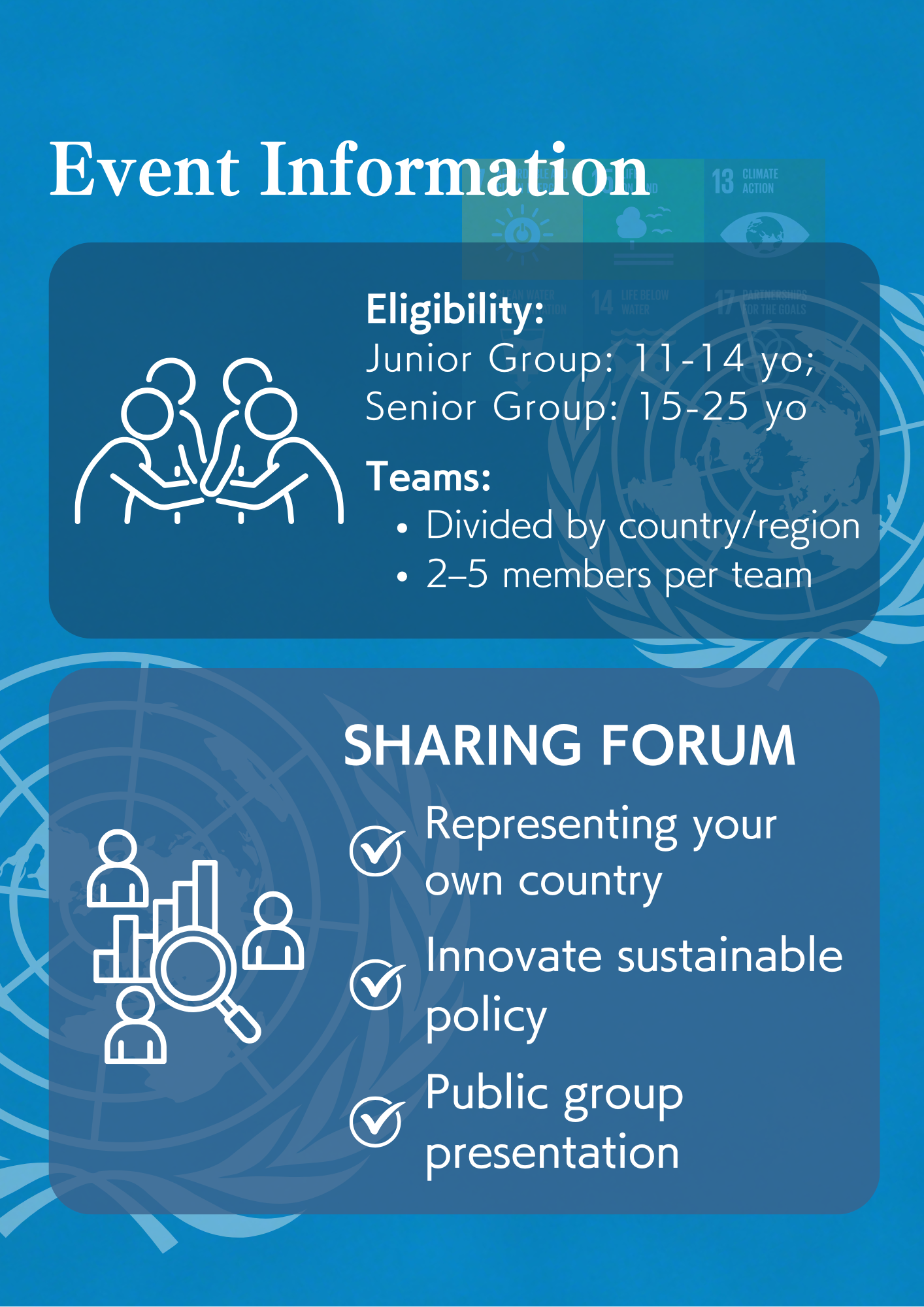
- Target Audience: Junior Group 11-14 years old, Senior Group 15-25 years old (Junior Participants must be accompanied by a teacher or partent)
- Competition Theme: All academic content and competitive elements are aligned with the 17 SDGs, challenging participants to explore global challenges and translate international goals into localised, practical policy solutions for their own country or region.
Target Audience
International students with a strong interest in:
- Global affairs and international relations
- Sustainability and the UN Sustainable Development Goals
- Leadership, public policy, and social impact
- Academic enrichment beyond the classroom
- Exposure to international institutions and policymaking
- Meaningful cross‑cultural experiences and global networks
Core Academic Component
Group Policy Competition
- Participants are grouped by region or country
- Policy topics are assigned randomly
- Teams design an original public policy proposal addressing an SDG‑related challenge
- Proposals are informed by:
- Knowledge gained from the UNESCAP visit
- Forum discussions and peer collaboration
- Final presentations are delivered in a formal forum setting
Schedule
| Day 1 |
|
| Day 2 |
|
| Day 3 |
|
|
Day 4 |
|
Key Learning Experience
1. Exclusive UNESCAP Visit
- Guided behind‑the‑scenes tour
- Briefing on UNESCAP’s current work and future plans
- Insight into how international policies are developed and implemented
2. Forum Sessions & Presentations
- Group policy development
- Formal presentations evaluated by judges
3. Cross‑Cultural Exchange
- International networking sessions
- Cultural activities and city exploration in Bangkok
Awards & Recognition
Participants are recognised through a range of academic and performance‑based awards, including:
- Champion, 1st Runner‑Up, 2nd Runner‑Up, Merit Awards
- Special Awards:
- Best Presenter
- Best Delegate
- Most Outstanding Performance
- Medals and certificates issued by KNF & RCF, with certificates endorsed by the United Nations

In partnership with

Learning Outcomes
By the end of the programme, participants will be able to:
Demonstrate a sophisticated understanding of the UN Sustainable Development Goals, including their global significance and local application.
Analyse real‑world social, economic, and environmental challenges using policy‑based frameworks informed by international best practice.
Design and present an original policy proposal tailored to their own country or region, integrating insights gained from UNESCAP and peer collaboration.
Communicate ideas persuasively and professionally in an international forum setting, demonstrating confidence, clarity, and intellectual maturity.
Collaborate effectively in diverse, multicultural teams, showing leadership, adaptability, and respect for differing perspectives.
Develop global awareness and civic responsibility, strengthening their identity as future changemakers and ethical leaders on the world stage.
By the end of the programme, participants will be able to:
Demonstrate a sophisticated understanding of the UN Sustainable Development Goals, including their global significance and local application.
Analyse real‑world social, economic, and environmental challenges using policy‑based frameworks informed by international best practice.
Design and present an original policy proposal tailored to their own country or region, integrating insights gained from UNESCAP and peer collaboration.
Communicate ideas persuasively and professionally in an international forum setting, demonstrating confidence, clarity, and intellectual maturity.
Collaborate effectively in diverse, multicultural teams, showing leadership, adaptability, and respect for differing perspectives.
Develop global awareness and civic responsibility, strengthening their identity as future changemakers and ethical leaders on the world stage.